

Dr. Purvi Ankit Gohil
Registered Dentist
BDS (Maharashtra University of Health Sciences, India)
Speaks English, Hindi
Dental veneers are thin shells bonded to the front of the teeth to improve discolouration, chips, gaps or uneven shape. At Bayside Dental Tung Chung, Hong Kong, we assess patients for porcelain and composite veneers; porcelain veneers usually take two visits over about 1–2 weeks and are custom-made by a dental laboratory.

Registered Dentist
BDS (Maharashtra University of Health Sciences, India)
Speaks English, Hindi
Veneers (sometimes called veneer teeth) are custom-shaped shells bonded to the front surface of the teeth to change their colour, shape or length. The two common materials are porcelain and composite resin: porcelain veneers are made by a dental laboratory, have a translucency close to natural teeth and resist staining better; composite veneers are shaped directly on the tooth, usually in one visit and at a lower cost, but stain and chip more easily.
Veneers mainly improve the look of visible teeth such as the front teeth. Common reasons include:
The cost depends mainly on the number of veneers, the material (porcelain or composite) and the complexity of the case. The range below is from the Prince Philip Dental Hospital’s published fee schedule (third-party public information, for reference only, not our clinic’s fees):
| Item | Reference range (HKD) |
|---|---|
| Crown / bridge / onlay / inlay / veneer (per unit) | $7,700 – $12,000 |
These are Prince Philip Dental Hospital reference fees, for reference only and not our clinic’s actual fees; your fee is confirmed after examination.
Your actual fee is confirmed after an examination; you can have as few as one veneer. We explain the expected cost before any treatment starts. See our Dental Fee Reference page for more.
Translucency close to natural teeth, colour-matched to the neighbouring teeth.
Porcelain doesn’t pick up stains easily; composite tends to yellow over time.
Compared with a crown, usually only about 0.5 mm of enamel is removed.
Whitening changes colour only; veneers can also refine shape, length and small gaps.
With good care, typically 10–15 years.
If you’d like porcelain veneers completed in a single visit, we can refer you to our group’s Smith & Jain Dentists in Central, where same-day veneers are made with CEREC® (your dentist will assess whether it suits you). See the Smith & Jain Veneers page.
| Porcelain veneers | Composite veneers (instant veneers) | |
|---|---|---|
| How they’re made | Custom-made by a dental laboratory | Shaped directly on the tooth by the dentist |
| Tooth reduction | Usually about 0.5 mm of enamel | Little or none |
| Visits | Usually 2, over about 1–2 weeks | Usually 1 |
| Lifespan | Typically 10–15 years | Typically 5–7 years |
| Staining | More stain resistant | Stains more easily; needs periodic polishing |
| Chips | Usually need replacing | Small chips can usually be repaired |
| Often suits | Long-term change in colour and shape | Small chips or gaps, or trying a look first |
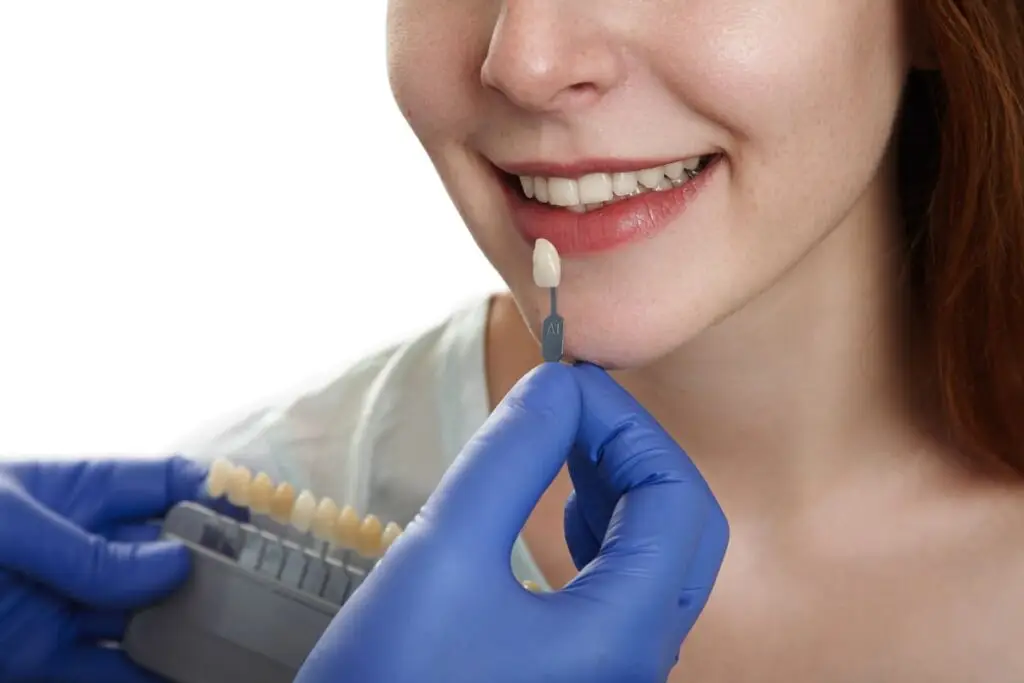
Porcelain veneers are usually about 0.5–1 mm thick and bonded to the front of the tooth. Because a small amount of enamel is removed, they are custom-made by a dental laboratory from a scan or impression. They look close to natural teeth, resist staining, typically last 10–15 years with good care, and suit people who want a long-term change in colour and shape.
Composite veneers, also called instant veneers, are shaped directly on the tooth by the dentist, usually in one visit, with little or no drilling and at a lower cost. Composite stains and chips more easily and typically lasts around 5–7 years, so it suits small chips, small gaps or mild discolouration.

| Teeth whitening | Veneers | Crowns | |
|---|---|---|---|
| Changes | Colour only | Colour, shape, length, small gaps | Rebuilds the whole tooth |
| Tooth reduction | None | A little (front surface) | More (all around the tooth) |
| Often suits | Healthy teeth, just want them whiter | Front-tooth appearance, tooth largely intact | Cracked or heavily filled teeth, or after a root canal |
Your dentist will usually start with the least invasive option: whitening, then composite bonding or composite veneers, then porcelain veneers, and a crown last. If you only want whiter teeth, teeth whitening is usually the first option; if a tooth is badly damaged or root-treated, a crown may suit it better. Your dentist will explain the options after an examination.
Number of Visits: usually 2 for porcelain (usually 1 for composite)
Completion Time: about 1–2 weeks for porcelain
Recovery Period: usually no downtime
We talk through what you’d like to change, examine your teeth and gums, take X-rays where needed to check for decay or gum disease, and recommend the number of veneers, material and expected cost.
About 0.5 mm of enamel is removed, the teeth are recorded by digital scan or impression and shade-matched, and the details are sent to a dental laboratory; temporary veneers can be placed while they’re made.
We try the veneers in to check shape, length and colour, clean the tooth surface, bond them with dental adhesive, cure them with a curing light and adjust your bite.
Talk through your expectations; finish any whitening first; tell your dentist if you grind your teeth.
Most people return to normal activities straight away; avoid very hard or sticky foods for the first few days. Brush and floss daily, don’t bite ice, hard shells or pens with your front teeth, wear a night guard if you grind, and keep up regular check-ups and cleanings.
If you’d like to improve the colour, chips or gaps in your teeth, book a check-up. Your dentist will first check your teeth and gums, then explain veneers, whitening or other options and the expected cost.
For porcelain veneers, local anaesthetic is used as needed while the enamel is prepared, so you usually feel only vibration. Teeth may be briefly sensitive to hot and cold afterwards, usually settling within 1–3 days. Composite veneers rarely need drilling or anaesthetic.
Porcelain veneers typically last 10–15 years with good care; composite veneers around 5–7 years. Grinding, diet and oral hygiene all affect how long they last.
It depends on what you want to change; you can have just one, for example to fix a single discoloured or chipped front tooth. For a whole-smile change, your dentist will suggest a number based on how many teeth show when you smile.
Porcelain resists staining; composite tends to yellow over time and needs periodic polishing. Your natural teeth and the veneer edges can still pick up stains, so regular cleanings help.
Whitening gel won’t change the colour of veneers. If you plan to whiten, do it first and have the veneers matched to your new shade so the colours stay consistent.
Porcelain veneers need a little enamel removed, so the treatment is irreversible. A veneer can be replaced by your dentist, but the tooth can’t return to its original state and will still need a restoration.
Porcelain veneers are made by a dental laboratory, last longer and resist staining, and usually take two visits; composite veneers are shaped directly on the tooth, usually in one visit and at a lower cost, but stain and chip more easily.
Veneers can improve the look of mildly uneven teeth, but they don’t change your bite or the position of the teeth; more noticeable crowding is usually treated with braces first.
Grinding raises the risk of chipping. Your dentist will assess it and usually recommend a night guard; in more severe cases other options may be better.
At Bayside Dental Tung Chung, porcelain veneers are made by a dental laboratory and usually take two visits over about 1–2 weeks, while composite veneers are usually done in one visit. If you’d like porcelain veneers in a single visit, we can refer you to our group’s Smith & Jain Dentists in Central for same-day CEREC® veneers; your dentist will assess whether it suits you.
Composite veneers rarely need drilling. Porcelain veneers usually need a little enamel removed. Thinner, minimal-preparation veneers also exist, but they are less able to mask dark teeth; your dentist can advise whether they are an option for you.
The Prince Philip Dental Hospital’s published range for a crown, bridge, onlay, inlay or veneer is HK$7,700–12,000 per unit (for reference only, not our clinic’s actual fees). Your actual fee depends on the number of veneers and the material, and is confirmed after an examination; see our Dental Fee Reference.