Dr. Joanna Joy N. Chiu
Specialist in Periodontology
FCDSHK (Perio), FHKAM (Dental Surgery)
DMD (Philippines), MDS (Perio) (HK), AdvDipPeriodont (HK)
M Perio RCSEd
Speaks English, Tagalog, Cantonese, Mandarin

Periodontal treatment removes the plaque and tartar that collect below the gumline, so inflamed gums can settle and bone loss slows. At Bayside Dental Tung Chung, we measure your gum pockets first, then plan a scale and polish or a deep cleaning (scaling and root planing), usually over 2–4 visits.


Specialist in Periodontology
FCDSHK (Perio), FHKAM (Dental Surgery)
DMD (Philippines), MDS (Perio) (HK), AdvDipPeriodont (HK)
M Perio RCSEd
Speaks English, Tagalog, Cantonese, Mandarin

Registered Dentist
BDS (HK), MFDS RCSEd, MFDS RCPS (Glasg)
Speaks English, Cantonese, Mandarin

Registered Dentist
BDS (Maharashtra University of Health Sciences, India)
Speaks English, Hindi

Specialist in Paediatric Dentistry
FCDSHK (Paed Dent), FHKAM (Dental Surgery)
BDS (Rajiv Gandhi University of Health Sciences, India), MDS (Paed Dent) (HK)
MPaed Dent RCSEd, MPaed Dent RCS (Eng)
Speaks English, Hindi
Gum disease (periodontal disease) is a chronic infection of the tissues that hold your teeth in place: the gums, the periodontal ligament and the jawbone. It starts when plaque and tartar build up along and under the gumline. In the early stage, gingivitis, only the surface of the gum is inflamed. Once bacteria move below the gumline, break down bone and form pockets around the teeth, it has become periodontitis.
See a dentist soon if you notice:
Smoking narrows the blood vessels in the gums and can hide bleeding, so smokers should have their gums checked regularly even if they see no blood. For causes, symptoms and the links with general health, read our periodontal disease guide.
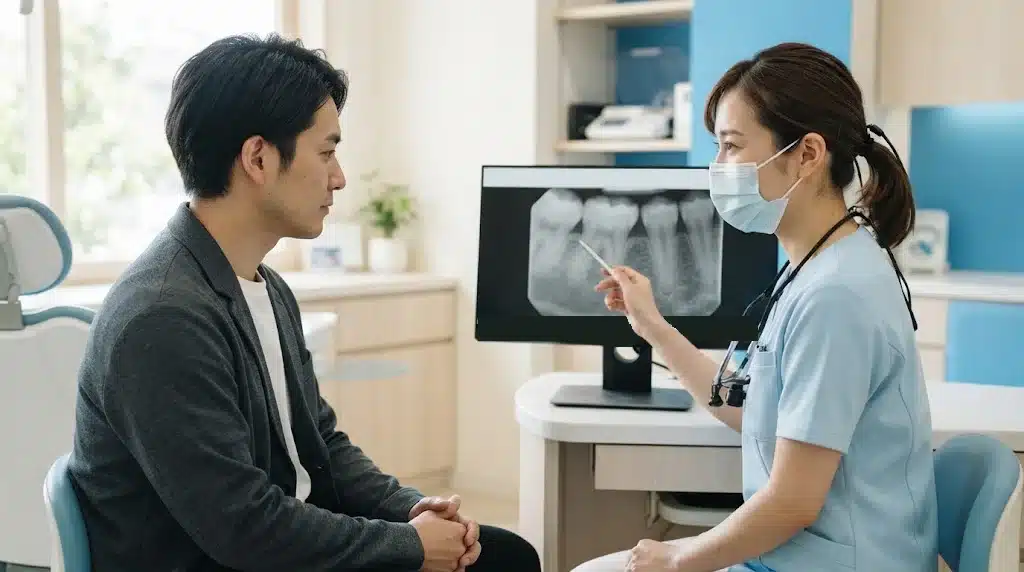
Your dentist examines your gums and uses a periodontal probe to measure the pocket around each tooth and note where it bleeds. X-rays may be taken to check your bone levels. Pockets of 4 mm or more mean bacteria have reached below the gumline, and the deeper the pocket, the more advanced the disease usually is.
Your gums are red and bleed when brushed, but the bone is not yet affected. A professional scale and polish removes the tartar, and with good brushing and daily flossing, gingivitis is usually reversible.
Infection has spread below the gumline and started to damage bone. Under local anaesthetic, your dentist uses ultrasonic and hand instruments to clear tartar and bacteria from the root surfaces, then smooths the roots so the gums can reattach. This is scaling and root planing, often called deep cleaning. It is usually done one section of the mouth at a time over 2–4 visits, each about 45–60 minutes.
After deep cleaning, your dentist books a follow-up visit to measure the pockets again to check whether the inflammation is under control and whether you can move on to maintenance or need further treatment.
When pockets are very deep, bone loss is severe or teeth are loose, deep cleaning alone may not reach all the bacteria. Your dentist may recommend periodontal surgery, such as flap surgery to clean deep root surfaces, or bone and soft-tissue grafts. A specialist in periodontology will assess whether surgery is needed.
Periodontitis needs ongoing care once it is under control. Patients usually return every 3–4 months for a maintenance clean that removes new plaque and tartar before the pockets deepen again.
A routine scale and polish usually doesn’t need numbing. Deep cleaning and gum surgery are done under local anaesthetic, so you generally won’t feel pain during treatment. If you feel anxious, let your dentist know before you start.
Once the anaesthetic wears off, your gums may feel sore for a few days and your teeth may be more sensitive to hot and cold. This is a common reaction. Take pain relief as your dentist advises and rinse with warm salt water. Contact us promptly if swelling or pain keeps getting worse, or if you develop a fever or facial swelling.
Early gingivitis can usually be fully reversed with a professional clean and better home care. Bone lost to periodontitis generally does not grow back, but with treatment the disease can be brought under control and stopped from getting worse.
Whether it comes back depends mostly on keeping plaque under control:
Smoking and diabetes both affect how well treatment works. Smoking reduces blood flow to the gums and slows healing. Poorly controlled blood sugar weakens the body’s ability to fight infection, and severe gum inflammation can make blood sugar harder to control. If you have diabetes, your gum treatment and your doctor’s diabetes care should go hand in hand.
There is no single fee for periodontal treatment. Your dentist needs to examine your gums and measure the pockets before giving a quote. The main factors are:
For Prince Philip Dental Hospital reference fees for periodontal treatment and why prices vary, see our dental fee reference page.
Bayside Dental Tung Chung is at Shop 26, Caribbean Square, 1 Kin Tung Road. We are open seven days a week, including Sunday 09:00–13:00, so residents of Caribbean Coast and the rest of Lantau can fit deep cleaning visits and maintenance cleans every 3–4 months around their week.
Our dentists speak English, Cantonese, Mandarin and other languages, so we can explain your pocket measurements and treatment plan in a language you’re comfortable with. The team includes general dentists and specialists, among them a specialist in periodontology, so more complex cases can have a specialist assessment. Meet the team on our dentists and hygienists page.
Bleeding gums, receding gums or a tooth that’s starting to feel loose? Booking is quick and easy. Your dentist will check your gums, measure the pockets and explain which step of treatment you need. Use the buttons below to WhatsApp us, call or book online.
No. Hardened tartar can’t be brushed away, so gum disease needs professional cleaning to stop. Early gingivitis is usually reversible with a scale and polish and better home care. Periodontitis needs deep cleaning or further treatment; lost bone generally doesn’t grow back, but the disease can be controlled. Read more in our https://baysidedentaltc.com/periodontal-disease-guide/ guide.
Deep cleaning and gum surgery are done under local anaesthetic, so you generally won’t feel pain during treatment. Afterwards, your gums may feel sore and your teeth sensitive to hot and cold for a few days; pain relief as advised by your dentist and warm salt-water rinses help. A routine scale and polish usually doesn’t need numbing.
Deep cleaning is usually done over 2–4 visits, one section of the mouth at a time, with each visit taking about 45–60 minutes. At a follow-up visit your dentist re-measures the pockets to decide whether you move on to maintenance or need more treatment. After that, patients usually return every 3–4 months.
The Prince Philip Dental Hospital fee schedule lists non-surgical periodontal treatment (deep cleaning, scaling and root planing) at about HK$3,000–8,000 per quadrant (a quarter of the mouth); these figures are for reference only, not our clinic’s actual fees, and your fee is confirmed after examination. Cost depends mainly on pocket depth, how much of the mouth needs treatment and whether surgery is needed. See https://baysidedentaltc.com/dental-fee-reference/.
Not necessarily. Mild to moderate gum disease is usually treated first with cleaning and deep cleaning, then the pockets are measured again. If pockets of 7 mm or more remain, bone loss is significant or teeth are loose, your dentist may recommend surgery such as flap surgery or grafting, assessed first by a specialist in periodontology.
No. Medicines only support treatment; the cause, plaque and tartar below the gumline, has to be removed by your dentist. For an acute flare-up, a gum abscess or a spreading infection, your dentist may decide antibiotics or an antibacterial mouthwash are needed. Painkillers only ease symptoms. If gum swelling comes with fever or facial swelling, seek care promptly: https://baysidedentaltc.com/emergency-dentist/.
Not everyone with gum disease needs a specialist; early to moderate cases are usually treated by a dentist with cleaning and deep cleaning. If pockets stay deep after deep cleaning, bone loss is marked or surgery may be needed, your dentist will arrange an assessment with a specialist in periodontology. Our team includes a specialist in periodontology: https://baysidedentaltc.com/dentist-and-hygienist/.
After periodontal treatment, patients usually need a maintenance clean every 3–4 months, more often than the 6-monthly clean for healthy gums. Your dentist sets the exact interval from your pocket depths, bleeding and how quickly tartar builds up. Keeping to it matters most if you smoke or have diabetes.
WhatsApp us, call +852 2185 6550 or book online. We are at Shop 26, Caribbean Square, Tung Chung, open Monday to Friday 09:30–18:30, Saturday 09:30–13:30 and Sunday 09:00–13:00, closed on public holidays. Book online: https://baysidedentaltc.com/contact-us/.
We accept Elderly Health Care Vouchers, so eligible seniors can use them towards dental consultations and treatment. Please ask us when you book whether a particular treatment is covered and how the vouchers will be applied.